.png)
Laser Skin Resurfacing in Northville, MI
For acne scarring, deep lines, and sun damage that lighter treatments haven't touched.
Ablative resurfacing with the Aerolase Era — real results, and real downtime we'll tell you about before you book.
Targeted areas from $300 · Full face from $900 · 1 to 14 days of healing depending on depth · Payment plans available
Founder Note
Claudia, Founder & Certified Laser Technician
Most of what we offer is designed around not disrupting your life. The Neo Elite treats acne and rosacea with no downtime at all. Microneedling costs you a day of looking flushed.
Resurfacing is different, and I want you to know that before you're in the chair.
Ablative means the laser removes the outer layer of skin in a controlled way, so your body rebuilds it. That rebuild is where the result comes from — new collagen, new surface, scars and lines that don't come back the same. It's also why you'll spend somewhere between 3 days and 2 weeks looking like you had something done.
If that trade is worth it to you, this is the most powerful tool in our practice. If it isn't, I have three other things that will get you partway there without the recovery, and we'll happily point you to them.
Is SKIN RESURFACING for you?
Era - Aerolase is likely right if:
-
You have acne scarring — the indented, textured kind that fillers and facials don't touch
-
You have deep lines around the eyes or mouth that aren't improving with anything topical
-
You have significant accumulated sun damage on the face, chest, or hands
-
You have surgical or injury scars you want softened
-
You've done microneedling or IPL and gotten partway there, but not far enough
-
You can protect a few days to two weeks of your calendar
Era - Aerolase is not right, or not right yet, if:
-
Your main concern is active acne — the Neo Elite treats that better, with no downtime
-
Your main concern is redness or rosacea — same answer
-
Your main concern is flat brown sun spots with no texture change — IPL is cheaper and gentler
-
You can't stay out of the sun during healing
-
You're pregnant or nursing
-
You've taken Accutane in the last six to twelve months
-
You have an active infection, cold sore, or open lesion in the area
-
You keloid, or have a history of keloid scarring
-
You have an event in the next three weeks
We'd rather turn you down today than have you unhappy in two weeks.
What Era - Aerolase treats
Acne scarring — Boxcar and rolling scars, the indented texture left behind after acne clears. This is what resurfacing does that nothing else does as well.
Fine lines and wrinkles — Especially the etched lines around the eyes and mouth that don't move with expression.
Sun damage — Not just the brown spots on the surface, but the leathery texture and thickened skin underneath years of exposure.
Tone and texture — Overall roughness, enlarged-looking pores, skin that doesn't reflect light evenly.
Scars — Surgical scars, injury scars, and raised or textured scarring.
Skin growths and benign lesions — Certain raised surface lesions.
We'll identify what's appropriate at your assessment.

Pricing
Diferent depths. You choose with us at your assessment.
**Medium resurfacing, full face — 1,200 dollars.** About 45 minutes. Removes the damaged surface layer and reaches the upper dermis where collagen rebuilding starts. Softens fine lines, evens sun-damaged texture, improves shallow scarring. Pink and peeling for about five days. One to three treatments depending on what we're correcting.
**Deep resurfacing, full face — 2,600 dollars.** About an hour and 35 minutes, numbing included. Goes further into the dermis, which is what deeper acne scars, surgical scars, and etched lines actually require. Recovery is real — roughly 10 to 14 days before you'd want to be in front of people. Usually one treatment, sometimes two.
**Neck — 500 dollars per area. Chest — 500 dollars per area.**
**Scar and lesion work — 500 dollars per named area.** One cheek, one temple, the chin, the upper lip, or a single surgical or traumatic scar. Most take one to three treatments. Scarring across a wider region is priced as a full face, because it's a different amount of work.
**Sun damage, per area — 300 dollars.** Crow's feet, frown lines, forehead lines, under-eye, smoke lines, and sun-damaged texture with pigment change. 1 to 3 treatments. If your pigment is sitting on smooth skin with no texture change, resurfacing is the wrong tool — that's what the Neo Elite is for, at lower cost and no downtime.
What is the right treatment for you?
Medium is right for you if your skin looks tired rather than damaged — fine lines, uneven texture, sun exposure, shallow scarring — and you can give up 5 days.
Deep is right for you if you have deep acne scarring, a surgical or traumatic scar, or etched lines that creams and microneedling haven't touched, and you can genuinely clear two weeks.
Not everyone needs a full-face treatment. If your concern is confined to one place, we price it that way.
Note from Claudia, Founder & Certified Laser Technician
Most people don't need the deepest setting. The honest recommendation is often a medium-depth treatment rather than the most aggressive one, because the results are comparable and the recovery is far easier to live with. That's the call I'll make with you at your assessment, and I'm not going to sell you downtime you don't need.
How SKIN RESURFACING with ERA Aerolase works
ERA from Aerolase is an Er:YAG laser.
It emits light at 2,940 nanometers, and that number is the whole reason it works the way it does.
Water absorbs 2,940nm light more strongly than any other wavelength in the laser spectrum — roughly an order of magnitude more than the CO2 wavelength older resurfacing lasers use. Your skin is mostly water. So when Era - Aerolase fires, the energy is absorbed almost entirely at the surface, in the layer being treated, and very little of it travels deeper as heat.
That's the difference. A CO2 laser removes tissue and heats a wide margin around it. Er:YAG removes tissue with a much narrower heat margin.
Practically:
-
Faster healing. Less collateral thermal injury means less to recover from.
-
Lower risk of post-inflammatory hyperpigmentation. Heat is what triggers pigment to overreact. Less residual heat, less risk.
-
More predictable depth. We can take off a defined amount rather than estimating through a heat zone.
The trade-off, and we'll be straight about it: less residual heat also means less collagen contraction than CO2 produces. Era Aerolase resurfaces exceptionally well. It is not primarily a tightening laser. If skin laxity is your main concern, that's a different conversation and possibly a different treatment.
Era's pulse is 300 microseconds. Short pulses deliver energy faster than heat can spread — the same principle behind the Neo Elite, applied to a different wavelength for a different job.
Note from Claudia, Founder & Certified Laser Technician
I trained as an electrical engineer before I trained in skin. When we tell you why a setting is what it is, it's because I understand the physics — not because that's what the rep said. Every laser protocol in this studio is one I wrote and one my team is trained on. Whoever treats you is following the same standard, because I set it.
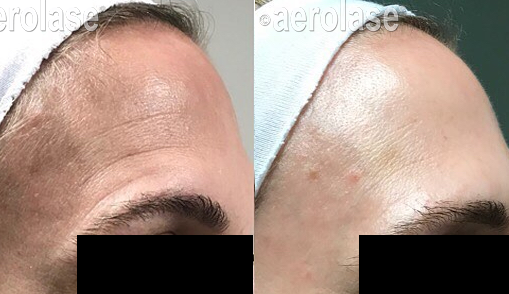
ERA - Skin Resurfacing
Skin tone: what we can and can't promise
Er:YAG has a real advantage here, and we don't want to overstate it.
Because 2,940nm targets water rather than pigment, Era AerolASE doesn't seek out melanin the way IPL does. That makes it meaningfully safer on deeper skin tones than IPL, and safer than CO2 resurfacing. It's one of the reasons we chose it.
But ablative is ablative. Any treatment that removes skin creates inflammation, and inflammation is what drives post-inflammatory hyperpigmentation in Fitzpatrick IV, V, and VI. Lower risk is not no risk.
Note from Claudia, Founder & Certified Laser Technician - The protocol I set
If you're Fitzpatrick IV or above and you want resurfacing, we do 3 things: we start at a more conservative depth than we'd use on lighter skin, we may pre-treat your skin for several weeks beforehand to calm pigment production, and we plan treatments with longer intervals between them.
That's a real protocol, not a disclaimer. It also means your first appointment is a conversation, not a treatment.
Prefer to avoid ablative entirely?
The Aerolase Neo Elite is designed for all skin tones with no downtime → Neo Elite Aerolase
Where Era Aerolase - Skin Resurfacing fits
We have four ways to change your skin. They stack; they don't compete.
Where ERA fits | What it does | Downtime | Best used for |
|---|---|---|---|
Era Resurfacing | Ablative — removes and rebuilds the surface | 1–14 days | Scarring, deep lines, heavy sun damage |
Aerolase Neo Elite | 1064nm, no downtime, all skin tones | None | Acne, rosacea, redness, melasma |
Microneedling | Controlled micro-injury to build collagen | 1–2 days | Texture, mild scarring, maintenance |
IPL Photofacial | Targets surface pigment and vessels | Spots darken ~1 week | Sun damage and redness, Fitz I–III |
A common path: microneedling to see how your skin responds and build a baseline → Era Aerolase to do the structural work on scarring and lines → Neo Elite Aerolase for maintenance and flare-ups after.
Not everyone needs all 4. Nobody needs all 4 at once. The point of the assessment is figuring out which one or two actually apply to you.
What healing actually looks like
What healing actually looks like. This is a medium-depth treatment. Superficial is milder and shorter; deep is more intense and longer. You'll get the version for your depth at your assessment.
Day 0. Immediately after, your skin feels like a strong sunburn — hot, tight, and red. That's expected. You go home with occlusive ointment and instructions.
Days 1 to 2. Peak swelling, usually the morning after. Your face feels tight and looks red. Sleep elevated. Keep the ointment on. Don't touch it.
Days 3 to 5. The redness organizes into a bronzed look, and the surface begins to flake. This is old skin lifting off. Do not pull it, pick it, or exfoliate it.
Days 5 to 7. Most of the flaking finishes. New skin underneath is pink and shiny. Mineral makeup is fine at this point.
Weeks 2 to 4. Pinkness fades. This is when people start telling you that you look well-rested.
Months 2 to 6. The real result. Collagen remodeling is slow — improvement in scarring and lines keeps building for months. What you see at week four is not the final answer.
During healing: no sun, no picking, no active ingredients, no swimming, no working out until we clear you. Broad-spectrum SPF every day afterward, permanently. Resurfaced skin that gets sun exposure will re-pigment, and you will have paid for nothing.
(Answered by Claudia, Founder)
Frequently asked questions (FAQs)
How much does it hurt?
Topical numbing goes on 45 to 60 minutes before we start, and for most people that's enough. You'll feel heat and a prickling sensation. Deeper settings are more intense. Afterward it feels like a bad sunburn for about 24 hours, and over-the-counter pain relief handles it.
Do I need more than one treatment?
For a full-face treatment, usually not — that's the point of going deeper in one session. Once every one to two years is typical for medium and deep, and every six to twelve months for superficial. Targeted scar work usually takes one to three treatments spaced several weeks apart.
Can I do this in the summer?
You can, but we'd steer you to October through March. Healing skin is highly sun-sensitive, and Michigan summer makes protection harder. Fall and winter give the best result and the easiest recovery.
Do I need a consultation first?
Yes, and for this treatment there are no exceptions. We need to see your skin, review your medical history and medications, discuss your Fitzpatrick type, and make sure you understand the recovery. Nobody books resurfacing without an assessment.
How long is the appointment?
Budget about two hours for your first one — numbing takes most of that. The laser portion of a full face is typically 30 to 45 minutes.
How is this different from microneedling?
Microneedling creates thousands of tiny channels to trigger collagen without removing the surface. Era removes the surface in a controlled layer. Microneedling is gentler, cheaper, and needs more sessions. Era does more per session and goes deeper on scarring. They work well in sequence.
Will it work on my acne scars?
Usually, on the indented and textured kinds — boxcar and rolling scars respond well. Ice-pick scars are narrower and deeper and often need a combined approach. You'll get a realistic expectation at your assessment rather than a promise.
What if I've had Accutane?
Wait six to twelve months after your last dose. Accutane affects how skin heals, and resurfacing too soon carries a real scarring risk.
When will I see results?
Surface improvement shows up as soon as the flaking finishes, around day seven. But the change in scarring and deep lines builds over three to six months as collagen remodels. Don't judge it at week two.
How is this different from the Aerolase Neo Elite?
Completely different jobs. Neo Elite is non-ablative — it treats acne, rosacea, redness, and pigment with no downtime, on every skin tone. Era removes and rebuilds the surface for scarring and deep lines. We have both because they don't overlap.
Can I do this if I have darker skin?
Yes, with a modified protocol — conservative depth, possible pre-treatment, longer intervals. Er:YAG is safer on deeper skin tones than IPL or CO2 because it targets water rather than pigment. But it isn't risk-free, and we'll walk you through exactly what that means for you before you decide.
Do you offer payment plans?
Yes. Details on our payment plans page, and we'll go through the options at your assessment.
Acne scars don't fade. Deep lines don't reverse with a serum. If lighter treatments have taken you as far as they go, resurfacing is the next real step — and it's a decision worth making with someone who'll tell you the recovery honestly before you commit to it.
Book a skin assessment. We'll look at your skin, tell you which depth we'd actually recommend, quote you a real number, and tell you plainly if we don't think you're a candidate.
Want more details, explore our Blog....